
Preparing for the IPO Window
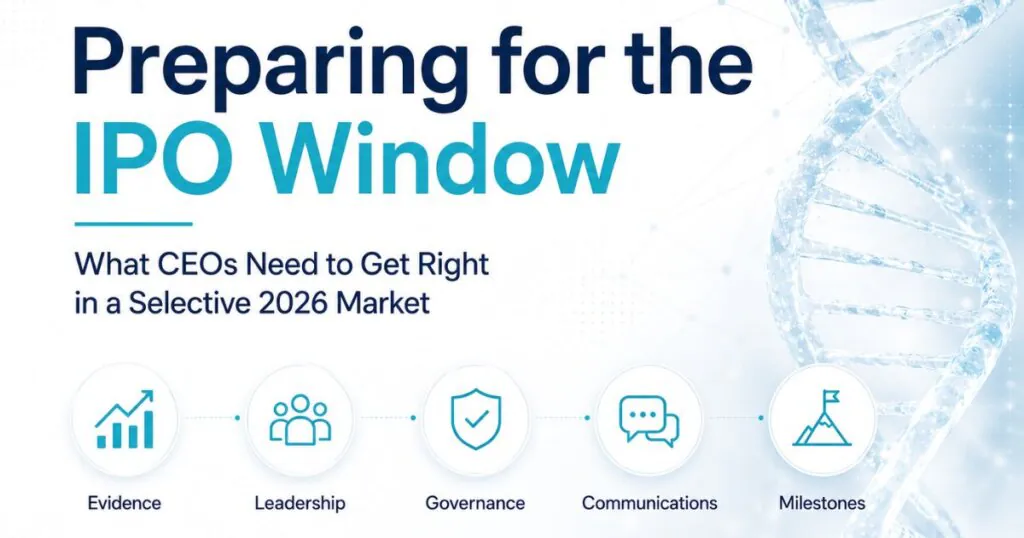
What CEOs Need to Get Right in a Selective 2026 Market
Executive Brief
| The life sciences IPO window is open, but selectively. In 2026, readiness is not a financing exercise – it is a strategic discipline that determines whether a company can enter the market with credibility, withstand scrutiny, and sustain valuation after the offering. |
Executive Summary
The 2026 life sciences IPO market is open, but selectively. Investors are backing companies that demonstrate maturity, credible progress, disciplined capital planning, and readiness to operate under public scrutiny. This is not a broad reopening for every company with a compelling story. It is a market that favors evidence, clarity, and management teams that can sustain credibility before and after the offering.
For CEOs, that changes the question. The issue is not simply whether the market is available. It is whether the company is ready to enter it. That means aligning science, strategy, governance, disclosure, and communications before the transaction begins. It also means addressing a more demanding set of investor questions: why this company, why now, and what value-creating milestones will support the story after the offering.
In this environment, IPO preparedness is a strategic discipline that creates optionality. Companies that prepare early can act when the window opens, wait for a stronger entry point, or pursue alternative paths from a position of strength. Companies that delay preparation may find the window narrows before they are ready.
What CEOs need to get right now
- Treat IPO readiness as a strategic decision, not a market-timing decision.
- Define a credible public-market thesis: why go public, why now, and what investors are asked to believe.
- Demonstrate evidence, not just promise, across science, milestones, capital discipline, and leadership readiness.
- Build communications readiness early, including message discipline, spokesperson preparedness, disclosure processes, and issue-response capability.
- Prepare for the market that follows the offering, not just the roadshow itself.
- Use readiness to create optionality, whether the company goes public now, later, or via another path.
“The strongest companies are not necessarily those with the biggest stories.
They are the ones with the clearest stories.”
1. The 2026 IPO Market Is Selective, Not Broadly Reopened
The 2026 life sciences IPO market is not a return to the more permissive environment of 2020 and 2021. Investors are no longer underwriting early-stage promise based on enthusiasm alone. Companies attracting support typically present a complete public-company case: credible validation, clear milestones, disciplined capital planning, experienced leadership, and communications that can withstand scrutiny.
This is a quality-driven market. Successful offerings are typically better prepared, more institutionally supported, and easier for investors to understand. Public investors continue to favor tangible evidence of progress: differentiated assets, clearer regulatory paths, credible commercial potential, strong intellectual property, and sufficient capital discipline to reach the next meaningful value inflection point. The strongest companies are not necessarily those with the biggest stories. They are the ones with the clearest stories.
That makes the CEO’s timing decision more nuanced. A company should not pursue an IPO simply because a window appears to be open. It should do so only if it has a compelling reason to be public now and if the next milestones are strong enough to support a public-market narrative once financing is complete. The likely presence of large technology, AI, and space-related offerings may further raise the bar by competing for investor attention and media oxygen.
“An IPO without a credible post-offering milestone cadence can leave a company exposed.”
2. Communications Readiness Connects Strategy to Valuation
Legal, financial, and governance readiness are essential. Communications readiness connects those disciplines to market understanding. A company preparing for the public markets must be able to explain complex science with precision and clarity, communicate consistently across audiences, and manage how information is conveyed during periods of heightened scrutiny.
For CEOs, this is not a branding issue. It is a market-readiness issue. A public-markets communications platform should enable the company to articulate a clear corporate narrative, explain the science and the business model with equal clarity, communicate consistently across investor materials and public channels, and prepare leadership to communicate under pressure without compromising credibility or compliance.
A strong platform typically includes message architecture for key stakeholders, a compliant external communications process, trained spokespeople, scientific and conference strategy, digital and social guardrails, issues-response protocols, investor Q&A preparation, and milestone-based planning. In a selective market, those capabilities are not optional refinements. They are essential to a company’s credibility.
Communications readiness should include: narrative clarity, investor messaging, disclosure discipline, spokesperson preparation, digital guardrails, scientific visibility, and issue response.
3. Investors Want Evidence, Milestones, and Management Discipline
Today’s IPO market rewards companies that can translate technical progress into investor confidence. That requires more than strong science. It requires a disciplined narrative that links the science to patient need, market opportunity, regulatory pathway, competitive differentiation, and management execution.
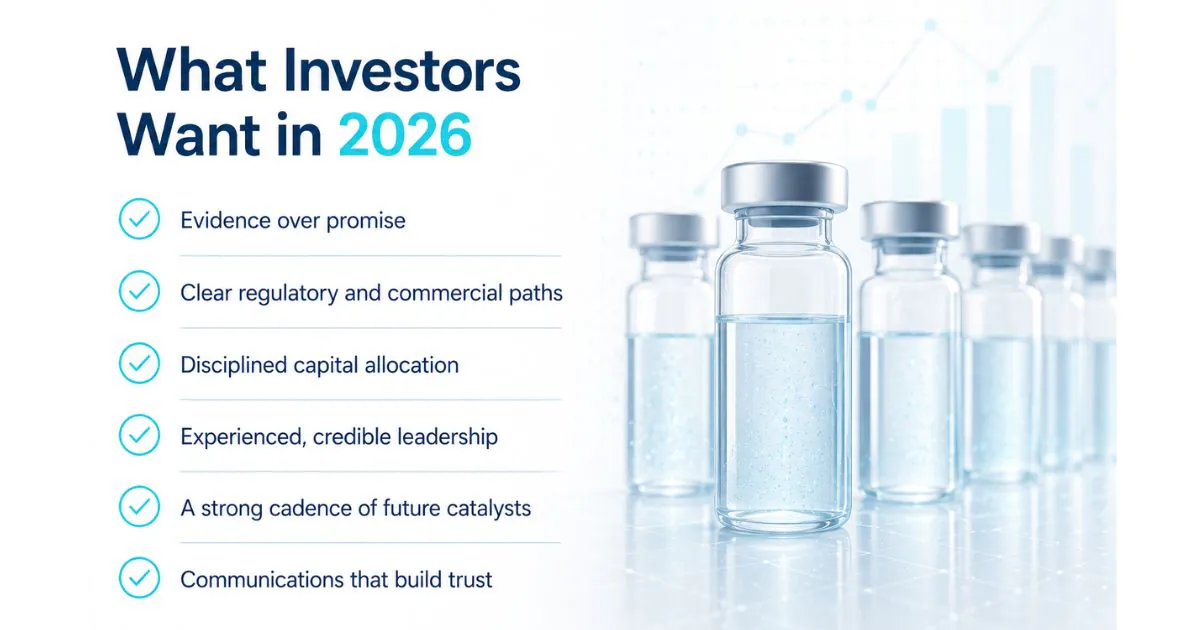
For clinical-stage companies, evidence may include a meaningful Phase 2 or Phase 3 data package, a validated target, a defined regulatory pathway, or a pipeline with multiple value-creating shots on goal. For platform companies, evidence may include proof that the platform can generate product candidates, partnerships, or clinical progress, rather than scientific promise alone. For AI-enabled life sciences companies, investors will want to understand how the technology creates measurable value in development, manufacturing, or commercial execution.
Management readiness also matters. Investors are assessing whether leadership can communicate material updates, manage expectations, explain risk, and maintain credibility across clinical, regulatory, financial, and corporate milestones. The roadshow is not the test. The post-IPO operating environment is.
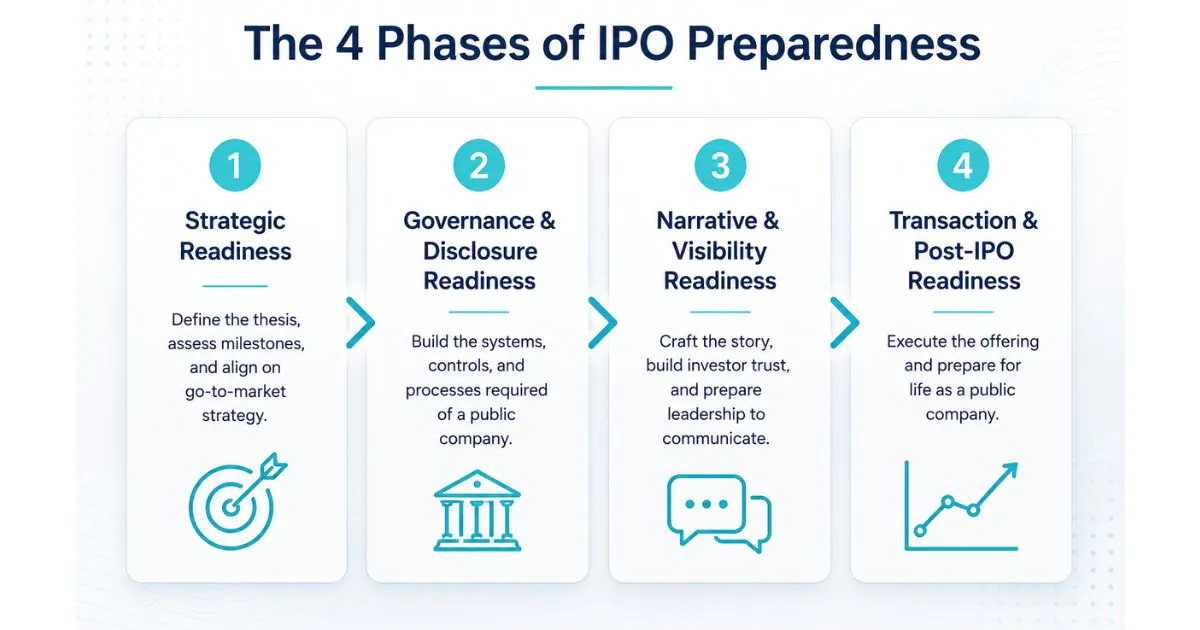
IPO Preparedness
| Phase | What it requires |
| Phase 1: Strategic readiness | Determine whether an IPO aligns with the company’s strategic plan. Assess capital needs, valuation expectations, investor appetite, upcoming milestones, and alternative financing options. The CEO and board should align on the public-market thesis: why go public, why now, and what investors are being asked to believe. |
| Phase 2: Governance and disclosure readiness | Build the systems required of a public company, including board and committee structure, financial reporting, internal controls, disclosure controls, cybersecurity oversight, Regulation FD practices, insider-trading policies, and crisis protocols. Governance quality is integral to market credibility. |
| Phase 3: Narrative and visibility readiness | Prepare the market to understand the company through corporate positioning, investor messaging, scientific communications, media strategy, conference planning, digital presence, and leadership visibility. The objective is disciplined visibility, not promotion. |
| Phase 4: Transaction and post-IPO readiness | Prepare for the offering and the first year as a public company, including roadshow messaging, investor targeting, analyst education, employee communications, earnings preparation, milestone disclosure planning, and issue management. The IPO marks the start of a more visible operating environment, not the finish line. |
5. Readiness Creates Optionality
A selective market does not mean every qualified company should go public as soon as possible. It means CEOs should view the IPO as one strategic option among several. A company may be ready to move forward if it has a strong data package, a differentiated pipeline, a clear use of proceeds, a credible capital plan, and leadership prepared for investor scrutiny. It may be better served by waiting if the next data readout, regulatory milestone, partnership, or financing event could materially strengthen its position.
Alternative paths may also merit consideration. Traditional IPOs remain the primary route for many life sciences issuers, but Regulation A offerings, SPAC or de-SPAC transactions, direct listings, reverse mergers, and uplistings may be viable in the right context. None of them should be treated as shortcuts. Structure does not replace substance. The market will continue to ask the same questions about science, capital, governance, milestones, leadership, and risk.
The core principle is straightforward: readiness creates optionality. A company that prepares early can act when conditions are favorable, wait for another milestone to strengthen its story, or pursue alternative financing paths without losing credibility. A company that waits to prepare until the market is clearly open may already be behind.
Questions Every CEO Should Ask Before Pursuing an IPO
- What is the company’s next major value inflection point? • Is the management team prepared to communicate consistently under pressure?
- Does the IPO fund the company to that milestone? • Are disclosure controls, cybersecurity governance, and crisis protocols ready?
- Is the science understandable to sophisticated generalist and specialist investors? • Would staying private through the next milestone create a stronger entry point?
- Is the evidence strong enough for public-market scrutiny? • Are alternative financing or transaction paths strategically superior?
- Is the regulatory pathway clear enough to support the investment case? • Can the company maintain credibility after the IPO, not just during the IPO?
- Is there a credible flow of meaningful data after the offering?
Conclusion
The life sciences IPO market in 2026 offers opportunity, but not indiscriminate opportunity. It is a market for companies that can demonstrate readiness, not merely ambition. For CEOs, the right approach is to treat IPO preparedness as a strategic discipline that aligns science, milestones, governance, disclosure, and communications before the transaction begins.
Companies that do so put themselves in a stronger position to enter the market, remain private longer, or pursue alternatives from a position of strength. In this environment, preparedness is not separate from strategy. It is the strategy.
About LaVoie Strategic Communications Group, Inc.
LaVoie Strategic Communications Group advises organizations across health, science, commercialization, and high-stakes communications. This brief is intended as an executive perspective on IPO preparedness in a selective 2026 market and can be paired with deeper planning around narrative readiness, investor visibility, milestone communications, governance, and issues preparedness.
Source note: Select market commentary incorporated from BiotechTV’s interview with Darren Campili, Global Head of Healthcare Investment Banking at RBC Capital Markets, posted on LinkedIn in May 2026.
Share This Post